Global South Innovation Technology Trends: The Hidden Economic Logic Behind

Dr. Amara Okonkwo
Trade Policy • Economic Development • Regional Integration
Key Takeaways
This article will examine the structural forces shaping innovation in the
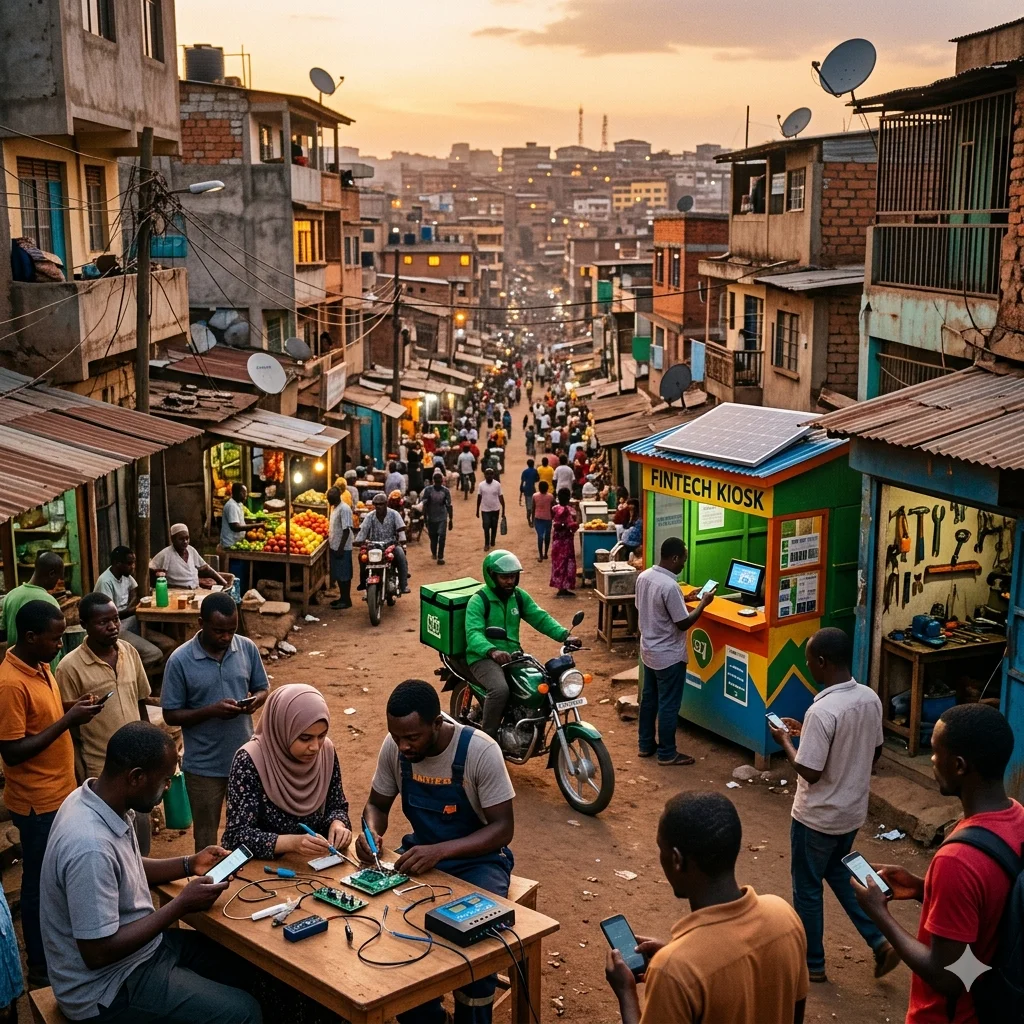
- •Global South Innovation Technology Trends: The Hidden Economic Logic Behind the Next Growth Wave [IMAGE: A cinematic panoramic scene showing a diverse cityscape in the Global South with mobile phones, solar powered devices, fintech kiosks, delivery riders, small informal businesses, local makers, and engineers collaborating around low cost technology, warm natural light, realistic documentary style, no text, no watermark] Global South innovation technology trends are often described with familiar labels: leapfrogging, startup ecosystems, and digital transformation.
- •Those terms are not wrong, but they are incomplete.
- •The deeper story is economic rather than purely technological.
- •In much of Africa, South Asia, Southeast Asia, Latin America, and parts of the Middle East, innovation is shaped by affordability, infrastructure gaps, informal commerce, and the need to solve immediate daily frictions.
This article will examine the structural forces shaping innovation in the
Global South Innovation Technology Trends: The Hidden Economic Logic Behind the Next Growth Wave
[IMAGE: A cinematic panoramic scene showing a diverse cityscape in the Global South with mobile phones, solar-powered devices, fintech kiosks, delivery riders, small informal businesses, local makers, and engineers collaborating around low-cost technology, warm natural light, realistic documentary style, no text, no watermark]
Global South innovation technology trends are often described with familiar labels: leapfrogging, startup ecosystems, and digital transformation. Those terms are not wrong, but they are incomplete. The deeper story is economic rather than purely technological. In much of Africa, South Asia, Southeast Asia, Latin America, and parts of the Middle East, innovation is shaped by affordability, infrastructure gaps, informal commerce, and the need to solve immediate daily frictions.
That means the most important advances are not always the most advanced in a laboratory sense. They are the ones that can be deployed cheaply, survive unreliable power or logistics, work on low-cost smartphones, and fit into fragmented local workflows. In this environment, technology is not merely an expression of ambition. It is a response to constraint.
Innovation Begins with Constraint
The core axis of innovation in the Global South is not “more R&D at any cost.” It is the redesign of tools for environments where capital is scarce, infrastructure is uneven, and consumer budgets are tight. This is why so many successful products are built around small transactions, mobile interfaces, and practical problem-solving rather than around heavy hardware or expensive enterprise software.
A payment app that works on an entry-level phone is often more valuable than a sophisticated platform that assumes broadband. A delivery network that can route around traffic, patchy addressing systems, and informal merchants may be more relevant than a highly optimized system built for a neatly mapped city grid. A solar home system can matter more than a distant promise of full-grid electrification.
This is also why technology adoption patterns in emerging markets tech should be read as adaptations to lived conditions. Demand is concentrated around everyday needs: payments, logistics, health access, education, energy, and agriculture. The strongest products reduce cost, time, and uncertainty. That simple fact explains much of the growth wave now taking shape.
[IMAGE: A split-scene of low-cost technology being used in markets, farms, and urban neighborhoods]
Why This Topic Demands Slow Analysis
This subject is best treated as slow analysis, not fast commentary. There is no single news event that fully explains the rise of mobile-first innovation or the spread of digital transformation across the Global South. Instead, the trend emerges from a stack of structural indicators: smartphone penetration, mobile money usage, merchant digitization, logistics expansion, cloud adoption, and sector-specific investment patterns.
A useful article therefore needs to combine multiple evidence types:
- investment flows into regional startup ecosystems,
- adoption data for smartphones and mobile payments,
- logistics and delivery network growth,
- industry case studies in health, farming, and energy,
- and policy changes affecting digital infrastructure.
Timeliness matters, but mainly as context. The real task is to identify the underlying market logic that persists even when funding cycles change or headlines fade. Slow analysis is essential because structural shifts in emerging markets tech often look small at first, then compound through daily use, local trust, and network effects.
[IMAGE: An analyst reviewing charts, regional maps, and market dashboards on a desk]
Leapfrogging Is Really Infrastructure Substitution
The phrase “leapfrogging” is common in discussions of Global South innovation technology trends, but it can obscure more than it reveals. What often happens is not a clean jump over one development stage into another. Instead, new tools substitute for missing, costly, or unreliable infrastructure.
Mobile money is the clearest example. Where bank branches are sparse and formal account ownership is low, digital wallets become a transaction layer for wages, transfers, bills, and small purchases. This is not simply a clever app. It is a substitute for physical banking access.
The same pattern appears in app-based services, off-grid energy, and shared logistics. When roads are poor, power is unreliable, and delivery addresses are inconsistent, companies build around those constraints rather than waiting for them to disappear. They use digital tools to create a service layer that formal infrastructure has not yet provided.
The economic logic is straightforward:
- lower capex than building traditional systems,
- faster deployment across fragmented markets,
- and a better fit for local demand that is distributed rather than concentrated.
This is why mobile-first innovation keeps expanding. It is not because mobile is fashionable. It is because mobile is the most universal and cheapest interface for infrastructure substitution.
[IMAGE: A visual comparison of traditional infrastructure versus mobile-based service access]
Where Value Accumulates in the Supply Chain
One of the least discussed parts of the story is where value actually accumulates. In many Global South markets, the durable advantage is not just in the app itself, but in controlling distribution, payments, data, and last-mile customer relationships.
A startup that owns the transaction rail can learn purchase patterns, credit behavior, and merchant demand. A logistics platform that manages the last mile can become a gatekeeper for inventory movement. A digital payments provider that is embedded in daily commerce can become the default layer for merchants and consumers alike.
This matters because supply chains in emerging markets are often fragmented. Procurement may be informal, inventory visibility may be poor, and cross-border trade flows may be slowed by paperwork or unreliable intermediaries. Companies that reduce those frictions do more than improve convenience. They build control points.
These control points can shape the longer-term structure of markets. They influence who gets credit, which merchants are visible to suppliers, how quickly inventory turns over, and which routes become commercially viable. In other words, technology in the Global South is often about market formation as much as market efficiency.
[IMAGE: Logistics hubs, delivery networks, and digital payment interfaces connected in one ecosystem]
Sector-by-Sector: Where the Demand Is Most Visible
The strongest sectors in Global South innovation usually map to urgent local pain points. That is why fintech, healthtech, agtech, and energytech appear so frequently in startup ecosystems.
Fintech
Fintech remains central because payments are the entry point to digital commerce. In many countries, the first digital service people use is not a streaming platform or a productivity tool. It is a wallet, transfer service, or merchant payment system. Fintech enables commerce, credit scoring, and small-business formalization. It also creates a bridge between informal income and digital financial identity.Healthtech
Healthtech grows where access is fragmented, travel costs are high, and public systems are stretched. Telemedicine, appointment platforms, pharmacy delivery, and digitized records reduce the burden of distance and uncertainty. In many settings, the key value is not advanced diagnostics but reliable access and coordination.Agtech
Agtech reflects the reality that agriculture remains a major employer and income source across many emerging markets. Farmers benefit from weather data, input marketplaces, mobile advisory tools, and pricing information. The strongest products are those that help producers make better decisions with limited margin for error.Energytech
Energytech often centers on off-grid or distributed solutions such as solar home systems, battery storage, metering, and pay-as-you-go energy models. These products are especially relevant where grid reliability is poor or expansion is slow. Energy access is a foundational enabler for phones, businesses, clinics, and schools.Together, these sectors show that Global South innovation technology trends are grounded in necessity. The best products solve real bottlenecks, not abstract convenience problems.
Informality Is Not a Side Story
A common mistake is to view informality as a barrier to innovation rather than as a design condition. In many markets, informal merchants, small transport operators, neighborhood clinics, and micro-distributors make up a large share of economic activity. Any serious digital transformation strategy must work with that reality.
This is why products that support cash-in/cash-out, low-ticket transactions, flexible credit, lightweight onboarding, and local-language interfaces often outperform more rigid models. The systems that succeed are usually those that recognize how people actually earn, pay, and trade.
Informality also changes product design. Trust is built through agents, local networks, and repeat use, not only through brand recognition. Data collection is incremental. Customer acquisition may happen through a kiosk, a merchant, or a delivery rider rather than through a conventional online funnel.
The result is a different innovation stack—one that is more distributed, more local, and often more resilient than outsiders expect.
Why These Trends Matter Beyond the Region
The significance of these trends is not limited to the Global South. As companies, investors, and policymakers look for the next growth wave, they are increasingly confronting the fact that the most scalable systems may be the ones designed for constraint.
Products built for low-cost devices, unstable connectivity, and fragmented commerce often prove useful in many environments, including underserved rural regions and lower-income communities in developed markets. Supply-chain tools that improve visibility in difficult conditions can also be adapted to other complex markets. Payment infrastructure that supports small transactions and fast settlement can become relevant far beyond its original geography.
In that sense, emerging markets tech is not a peripheral story. It is a test bed for business models that may define the next phase of digital transformation globally.
Conclusion: The Real Logic Behind the Next Growth Wave
The hidden economic logic behind Global South innovation is simple but powerful: when resources are constrained, technology must become more adaptable, more affordable, and more local. That requirement changes what gets built, who gets served, and where value accumulates.
The next growth wave is likely to be shaped less by headline startup narratives and more by practical systems that solve ordinary problems at scale. Mobile-first innovation, infrastructure substitution, and control over supply-chain touchpoints are not side effects of development. They are the core mechanisms driving it.
For businesses and investors, the lesson is clear. To understand the future of innovation in the Global South, look first at the costs people face, the infrastructure they lack, and the workarounds they already use. That is where the real market signal lives.
Dr. Amara Okonkwo
Senior Economic Analyst specializing in emerging markets and South-South trade dynamics. Former World Bank consultant with 15 years of experience in African and Asian economies.